Dr. Neeraj Kumar Goyal: Championing Non-Operative Excellence in Pediatric Orthopedics
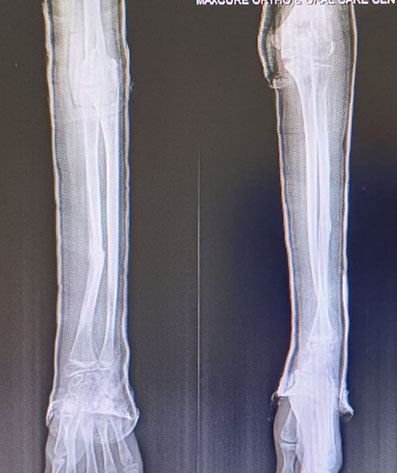
Hello everyone, I’m Dr. Neeraj Kumar Goyal, and I’m delighted to share a detailed look into a recent successful case. This involves a 13-year-old male with a displaced fracture of both forearm bones (radius and ulna). We successfully treated this injury conservatively using a specialized technique.
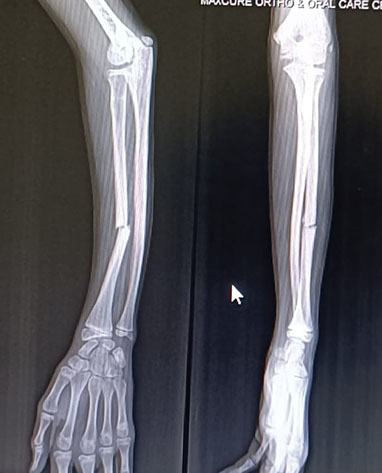
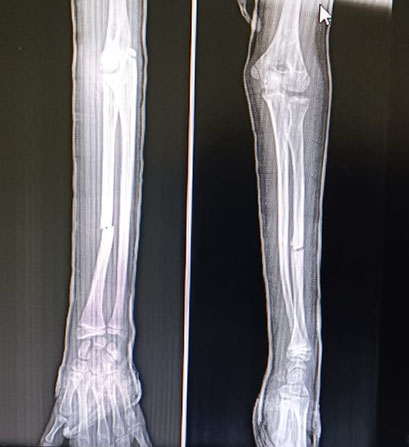
X-ray Post Injury
The Complex Anatomy and High Stakes of Forearm Fractures
The forearm is complex, comprising the radius and ulna, crucial for pronation and supination. Strong muscles and the interosseous membrane maintain the bone relationship. When both bones fracture, powerful muscles cause displacement, making stability difficult.
The Challenge: A Displaced Both-Bone Fracture
The patient’s fracture had significant displacement and angulation, often mandating surgery (ORIF) globally. Surgery risks damage to the active growth plates (physes) and requires hardware removal later. Our decision was guided by the child’s immense healing potential.
The Innovation: The Specialized Above-Elbow Cast in Extension
The core of our management was the two-phase technique: Closed Reduction followed by customized Casting Application. We aimed to achieve and mechanically maintain perfect anatomical alignment without incision.
Phase 1: Meticulous Closed Reduction
The procedure began under general anesthesia to ensure complete muscle relaxation. We used slow, sustained traction and manipulation to correct angulation and, critically, rotational malalignment. We confirmed the reduction instantly using fluoroscopy (real-time X-ray imaging).
Phase 2: The Above-Elbow Cast in Extension Technique
Traditional casting often fails to neutralize the strong deforming forces in this injury. We placed the elbow in near-full extension (straightened) to put key muscles on slack or tension. This position, combined with specific rotational alignment, helps to “lock” the reduction.
A. The Position of Immobilization: Extension is Key
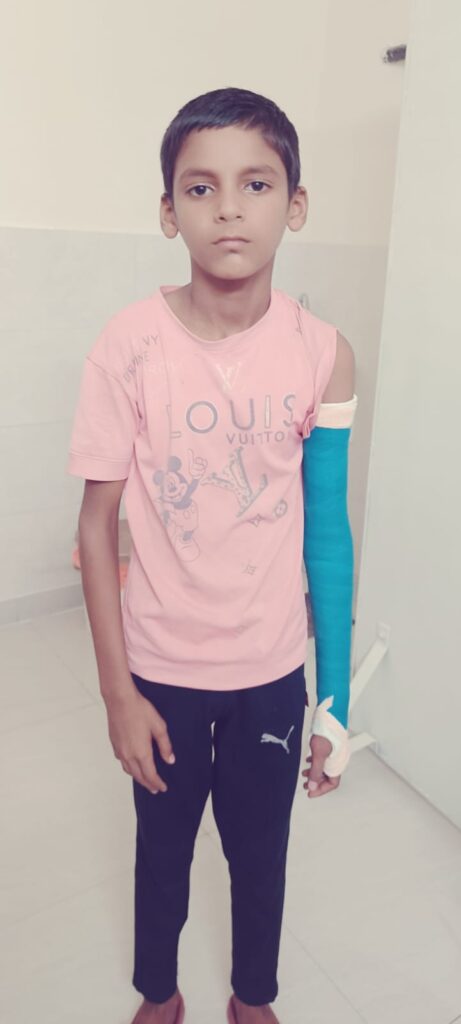
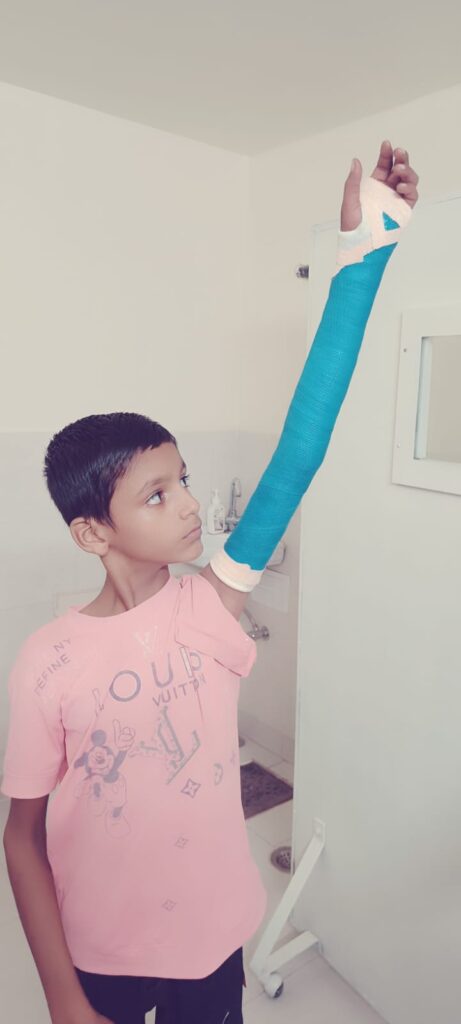
Placing the elbow in extension neutralizes forces from the brachioradialis and biceps muscles. This unique position acts synergistically with the rotational positioning to create a stable, tissue-based internal splint. The cast used was a tight, well-padded long-arm cast (above the elbow).
B. The Three-Point Mold Application
The cast was meticulously molded, incorporating a powerful three-point mold. This creates a constant external corrective force to maintain the perfect reduction secured by the specialized position.
Vigilance and The Triumph of Remodeling
Conservative treatment requires exceptional vigilance to prevent loss of reduction. We conducted weekly X-rays for the first few weeks, the most critical period. The patient’s age allows for significant pediatric remodeling to finalize the correction over time.
The Outcome: A Full Functional Recovery
After six weeks, the cast was removed, and the patient’s recovery was swift and complete. He achieved perfect anatomical alignment and full range of motion (pronation/supination). He was spared the risks of surgery, anesthesia, and the need for future hardware removal.
Final Thoughts and The Future of Pediatric Orthopedics
This case validates tailoring specialized mechanical techniques to a child’s unique biology. The above-elbow cast in extension technique proves that innovation can be non-operative. We prioritize returning young patients to their active lives with full function and minimal trauma.